
Foothills Clay Turns Weak Once It Gets Wet
On a sloped Boise lot, the ground does not always stay where it was graded. A bank creeps onto the patio, a strip of yard washes out after a hard storm, or an older wall starts tipping forward. All three come down to soil that will not stay in place on its own.
Much of the Boise Foothills is sand and silt left by an ancient lake called Lake Idaho, with clay mixed in across parts of the hills. That clay holds when it is dry. Once it soaks through, it turns weak and slippery and leans on anything holding it in place. The rim of the Boise Bench has slopes of its own. The Bench is a series of old river terraces cut by the Boise River, and many rim backyards drop toward the valley floor.
A4 Excavation builds retaining walls on Boise, ID hillside lots, rim lots, and flat yards that need a grade change. Our retaining wall installation for slope stabilization and erosion control starts below the surface, with a compacted base and a drainage path matched to the soil on your lot.
Is the Ground on Your Lot Starting to Move?
Let us take a look. We will walk the slope with you and tell you plainly what it needs.
Why Water Still Builds Up Behind Walls in a City This Dry
A retaining wall holds a slope at a height the soil would not keep on its own, which is how a hillside becomes a level patio or a usable side yard. It can also stop a bank from sliding onto the driveway. Most of the work that keeps a wall standing happens behind and beneath it, where you will not see it once the job is done.
Boise averages about 11.5 inches of rain and melted snow a year. July and August are close to dry. Even so, the soil behind a wall rarely stays dry for long. Canal water reaches Boise neighborhoods from about mid-April to mid-October, and lawn and garden watering adds water to the slope above many walls all summer. Most of the year’s moisture falls from November through May. Wet soil that freezes in winter swells and pushes against the wall, which is called frost heave.
Water adds weight and pressure to the soil it fills. A sound wall gives that water a way out: clean gravel behind the block, a perforated pipe at the base, and an outlet that carries it to daylight or into a drain line. With no path out, the pressure builds against the back of the wall. In a yard that stays damp through irrigation season, the wall drain can tie into drainage excavation for the rest of the lot.
Walls for Hillsides, Rim Lots, and Level Yards
Wall type follows the height, the load behind it, and the look you want. Here is the wall work we build and prep on Boise properties:
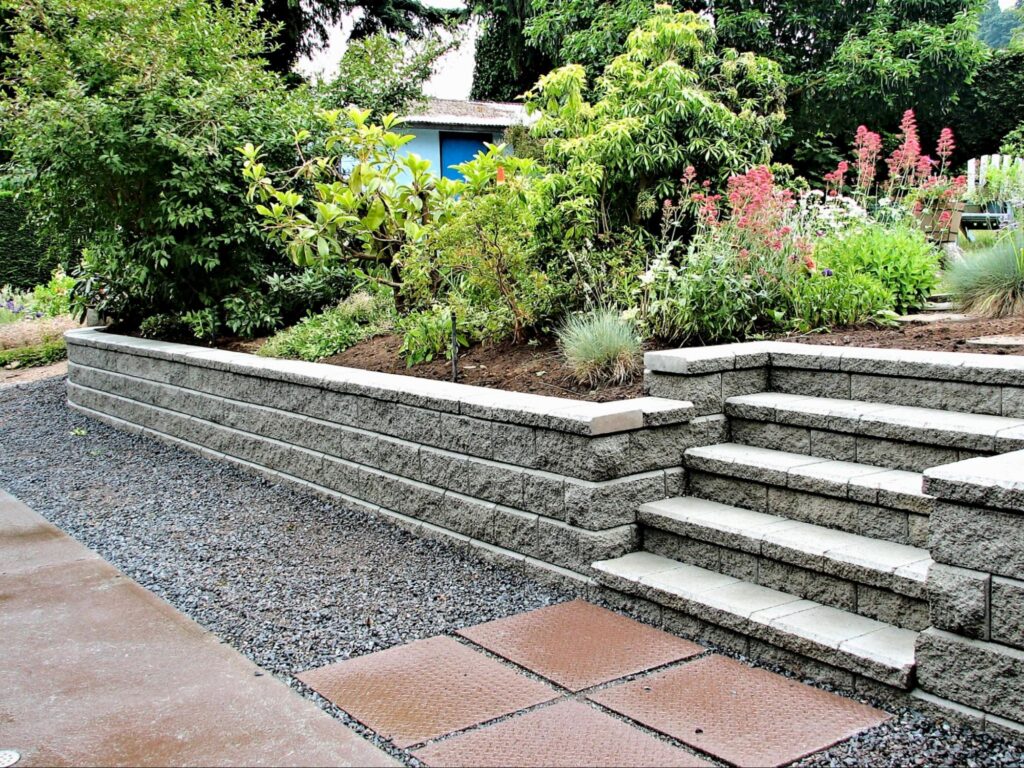
- Segmental Block Retaining Walls: Interlocking block with an even face that steps back into the slope.
- Natural Boulder Walls: Large stone placed for a rugged look that suits foothills lots.
- Terraced Walls for Steep Slopes: Two or more shorter walls that split a tall grade into level steps.
- Short Timber Garden Walls: A lower-cost option for raised beds and light grades, with a shorter life than block or stone.
- Base Excavation and Compaction: A level trench and a compacted gravel footing for the wall to build up from.
- Drainage Gravel and Perforated Pipe: Placed behind the wall as each course, or row of block, goes up.
- Finish Grading Around the Wall: The ground above and below is shaped so surface water runs away from the wall.
A 2-foot garden wall and a tall hillside wall can be built from the same block and still need very different bases, since height changes a build more than material does. We set those details on site, after measuring the grade.
Wondering Which Wall Fits Your Slope?
We will measure the grade on site and walk you through the options that fit it.
How Boise Draws the Line on Wall Height and Engineering
Boise sets clear points where a wall needs a permit or an engineer. Knowing them early keeps a project from stalling halfway through the plan.
The 4-Foot Rule
For any retaining wall 4 feet or taller, the City of Boise requires a building permit. Height is measured from the bottom of the footing to the top of the wall. The footing sits below grade, so a wall that shows about 3 feet above the yard can still cross that line. On hillside lots, city guidance calls for walls over 4 feet to be designed by an Idaho-licensed structural engineer.
Slopes and Loads Lower the Line
A wall as short as 2 feet needs engineering when it carries a surcharge. A surcharge is extra weight above or behind the wall, such as a driveway, a nearby structure, or a slope that keeps rising past the top course.
Stacked Walls Count Together
On hillside lots, city guidance treats terraced walls as a set. When 2 walls sit less than 10 feet apart and their combined height passes 4 feet, both must be engineered.
Setbacks Cap the Height
City code also caps the height of a single retaining wall inside a setback, the strip of yard along a property line where building is limited. A wall in a front setback, or in the clear vision triangle where drivers need to see around a corner, is capped at 36 inches. In other setbacks, the cap is 72 inches.
A4 measures a planned wall against each of these lines during the walkthrough, so you know early whether the wall needs a permit or an engineered design.
Owner-Led Wall Work on Boise Slopes
A4 jobs are owner-led, and the owner stays involved from the walkthrough through the build. Questions get answered by someone who has seen your ground.
A4 Excavation is a registered and insured Idaho contractor, Registration #076774. The same crew handles residential walls and commercial dirt work across the valley. A backyard terrace wall gets the same equipment and the same standard as a commercial grade change.
Hear It From A4 Customers
⭐⭐⭐⭐⭐
“I couldn’t be happier with the work A4 Excavation did. From start to finish, they were professional, honest, and incredibly easy to work with. They showed up when they said they would, communicated throughout the project, and the quality of their work exceeded my expectations. It’s hard to find contractors who take this much pride in what they do, but their attention to detail and work ethic really stood out. If you’re looking for an excavation company that does outstanding work at a fair price, I highly recommend A4 Excavation. I’ll definitely be using them again for future projects.”
— Nathan H., Verified Google Review
⭐⭐⭐⭐⭐
“I know Jezrael and his team and they are good, trustworthy people. Excellent work ethic, you’ll be happy with their service!”
— Isabela M., Verified Google Review
Picturing Flat Ground Where the Slope Is Now?
Tell us about the slope, and we will set up a free estimate.
Retaining Walls From the Foothills to the Bench Rim
We build walls on the steeper side of Boise, including Boise Heights, the Highlands near Crane Creek, and Warm Springs Mesa below Table Rock. Out east, Harris Ranch and the rest of Barber Valley sit where the foothills meet the Boise River. Southwest of downtown, Crescent Rim sits on the edge of the Boise Bench above Ann Morrison Park. Our retaining wall work across Boise also covers the rest of the Boise Bench and the North End. Past city limits, the same crew serves nearby Treasure Valley communities like Kuna and Star.
Let Us Read the Ground Before You Build
If you are weighing a wall against regrading or drainage alone, bring that question to the site visit. Some slopes need all three, and some need only one. When runoff is already cutting across the slope or pooling at a wall, we can plan Water Mitigation work as part of the same job. Contact A4 Excavation with a few project details, and we will set a time to see the property in person.
Boise, ID Retaining Walls FAQs
Do I need a permit for a retaining wall in Boise?
You need a City of Boise building permit for a retaining wall 4 feet or taller, measured from the bottom of the footing to the top of the wall. A wall as short as 2 feet needs engineering if it holds up a driveway, a structure, or a rising slope.
Does a wall on a hillside lot need extra city review?
Yes, if the lot is steep or the ground is unstable. In Boise, the Hillside Development Overlay applies where the slope on a property exceeds 15 percent. It also applies where the city finds unstable slopes, expansive soils (soils that swell when wet), high groundwater, springs, or erosion. A wall more than 4 feet tall above grade, or 2 or more walls less than 10 feet apart that add up to more than 4 feet, can call for a hillside permit. That review sits apart from the building permit, so a steep lot may need both before work starts.
How is a retaining wall priced?
A retaining wall is priced by the job. Length and height set most of the cost. Wall type, the depth of the base, drainage needs, and equipment access move it from there. A wall that needs an engineered design adds that design cost. A site visit is the only way to get a real number for your slope.
Should I change my sprinklers after a new wall goes in?
Often, yes. The drainage behind a wall is built to carry water away, but sprinkler heads that spray the strip right above the wall keep that soil wet longer. Turning those heads away from the wall, or switching that strip to drip lines, eases the load. We can point out which heads to adjust once the wall is in.
Can a leaning retaining wall be repaired, or does it need a rebuild?
Usually the section that moved has to be rebuilt. Bracing the face does not fix the footing, and adding block on top makes the wall taller and heavier, which can also push it past Boise’s 4-foot permit line. Old railroad tie walls are often replaced outright once the wood rots. We trace how far the movement runs, then tell you how much of the wall needs to come down.
When is the best time to build a retaining wall in Boise?
Late summer through fall is usually the easiest window. The soil is dry and firm, so base excavation and compaction go cleanly. Spring works once the ground dries out, but foothills clay that is still soaked from snowmelt is hard to dig and compact. Frozen ground in midwinter can slow or pause base work. We will look at your soil during the walkthrough and tell you plainly when it makes sense to start.
What is the average lifespan of a retaining wall?
Most retaining walls last anywhere from about 10 years to well past 50. The material, the base, and the drainage set most of that range. Treated timber sits at the low end, often 10 to 30 years, because the wood rots where it meets wet soil. Segmental block and boulder walls built on a sound base with working drainage sit at the high end and can last 50 years or more.